
Exclusive content!
Join Harry’s Newsletter
Receive regular content from Prof Harry Mond. This includes his popular “Fun with ECGs” and “What Do You Think” case studies, along with useful tools such as factsheets and video webinars.
Assoc Prof Harry Mond
CardioScan Medical Director
OAM | MBBS | PhD | MD | FRACP | FCSANZ | FACC | FHRS | FAPHRS
Associate Professor Harry Mond, a global expert in ECG and Holter studies, shares clinical cases, presentations, and insights from his vast cardiology experience.
Receive new content, straight to your inbox!
CardioScan Medical Director, Assoc Prof Harry Mond is a founding member of CardioScan and remains among the world's top experts in the interpretation of ECG and Holter studies. As an international educator and author of 295+ manuscripts and books, he provides regular training and professional development to our team of certified cardiac technicians to ensure the highest clinical standards.
December 8, 2025
Textbooks

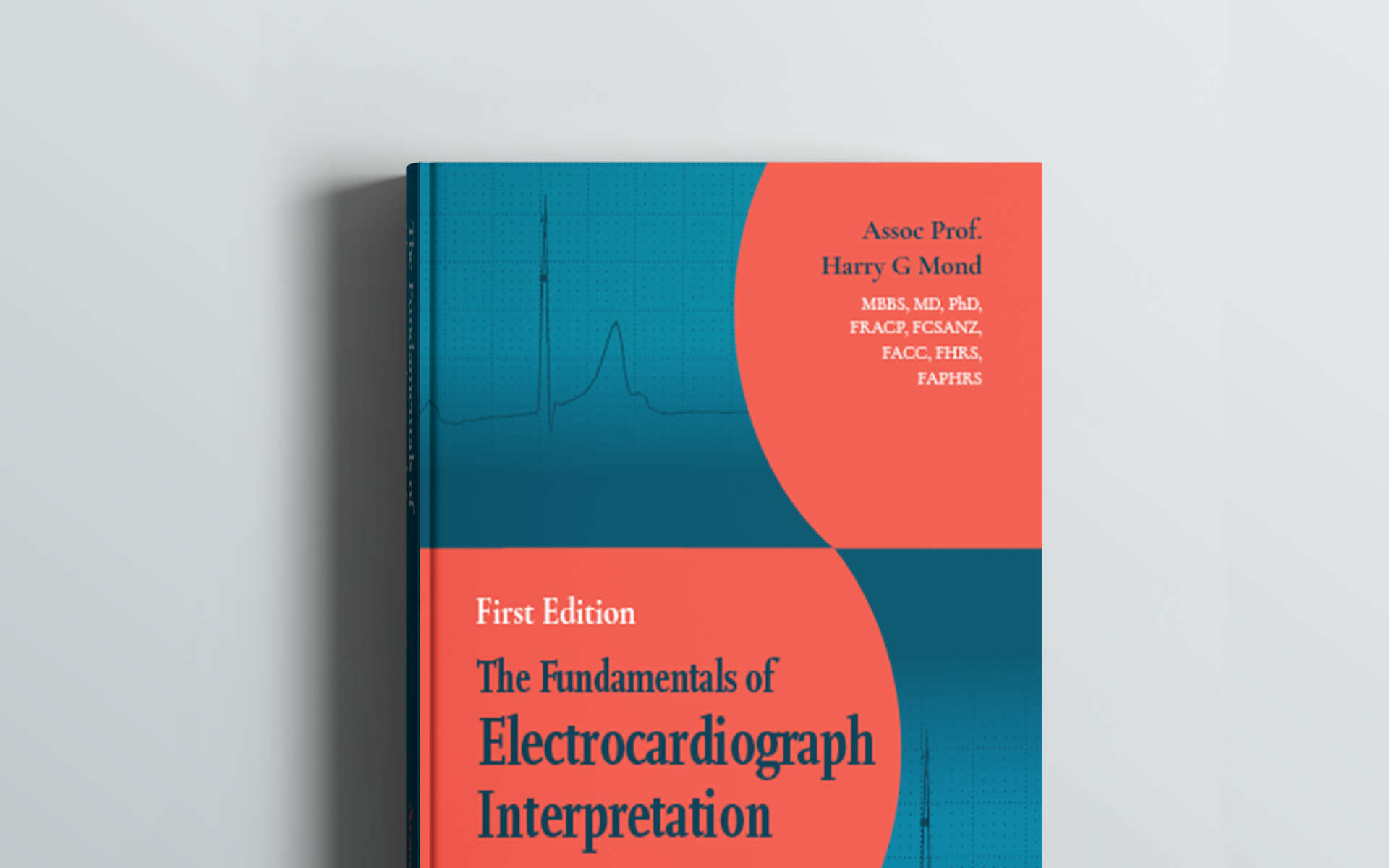
Fundamentals of Electrocardiograph Interpretation takes a unique approach to describing electrocardiography. This book offers comprehensive coverage of arrhythmias with focused descriptions and hundred of clearly presented illustrations. Covering a wide variety of arrhythmia examples, the book further explores and focuses on the often-overlooked topics like cardiac pacing, lead malposition, and ambulatory monitoring to ensure a wide overview into the science of ECG interpretation.
October 28, 2026
Fun with ECG’s
As its name implies, AVNRT is a reentrant junctional or supraventricular tachyarrhythmia which involves the fast and slow pathways within the AV node creating a self-perpetuating circus movement. It can be divided into typical (slow-fast) or atypical (fast-slow) as well as several rarer forms related to more than one slow or fast pathway with similar electrophysiological properties. On the ECG, they can be identified and differentiated by the positioning of the P wave in relation to the QRS complex, which in turn is related to the direction of the re-entrant AV nodal circuit. However, in about 60% of cases, the P wave is buried in the QRS/T and cannot be identified on the surface ECG.
October 14, 2026
Fun with ECG’s
Retrograde conduction is defined as conduction from an ectopic site to the atrium via the AV node or accessory pathway and referred to as VA conduction. II results in a P wave configuration which differs from an anterograde P wave, and in most ECG leads is inverted. The site from where the impulse originates can be the AV node, Bundle of His, distal conducting system or the body of the ventricles including ventricular pacing. On the ECG, the QRS complex usually precedes the inverted retrograde P wave but on occasion may follow it.
October 1, 2026
Fun with ECG’s
In 1970, I commenced work as a “novice” cardiologist at The Royal Melbourne Hospital. Training at that time was learning how to recognise the diastolic murmur of mitral stenosis and making sure the ECG and chest x-rays were the correct way up. As this was prior to coronary artery surgery, stenting and echocardiography, the ECG was a highly respected tool for the diagnosis of many conditions. I was fortunate to befriend a number of the gurus of ECG interpretation who taught me to look into the soul of an ECG. Today, even though the ECG is the first investigation performed by a cardiologist, the art of ECG interpretation has been lost because we depend on the new tools for cardiac diagnosis.Â
September 17, 2026
ECG Challenges
Dr Thura Thant asked for an opinion on this confusing ECG. By using arrows and highlight, the ECG bared its soul and gave me an answer. ‍See if you can work it out? What do you think?
September 17, 2026
ECG Challenges
Dr Thura Thant asked for an opinion on this confusing ECG. By using arrows and highlight, the ECG bared its soul and gave me an answer. ‍See if you can work it out? What do you think?
September 17, 2026
ECG Challenges
Dr Thura Thant asked for an opinion on this confusing ECG. By using arrows and highlight, the ECG bared its soul and gave me an answer. ‍See if you can work it out? What do you think?
September 17, 2026
ECG Challenges
Dr Thura Thant asked for an opinion on this confusing ECG. By using arrows and highlight, the ECG bared its soul and gave me an answer. ‍See if you can work it out? What do you think?
August 26, 2026
ECG Challenges
Is this the impossible pacemaker ECG? It took me a while to work out what was going on. Is it pacemaker malfunction?‍ What do you think?
August 26, 2026
ECG Challenges
Is this the impossible pacemaker ECG? It took me a while to work out what was going on. Is it pacemaker malfunction?‍ What do you think?
August 26, 2026
ECG Challenges
Is this the impossible pacemaker ECG? It took me a while to work out what was going on. Is it pacemaker malfunction?‍ What do you think?
August 26, 2026
ECG Challenges
Is this the impossible pacemaker ECG? It took me a while to work out what was going on. Is it pacemaker malfunction?‍ What do you think?
July 1, 2026
ECG Challenges
I came across these two tracings from the same patient during Holter reporting. Do you agree with the reported diagnoses?
July 1, 2026
ECG Challenges
I came across these two tracings from the same patient during Holter reporting. Do you agree with the reported diagnoses?
July 1, 2026
ECG Challenges
I came across these two tracings from the same patient during Holter reporting. Do you agree with the reported diagnoses?
July 1, 2026
ECG Challenges
I came across these two tracings from the same patient during Holter reporting. Do you agree with the reported diagnoses?
May 28, 2026
ECG Challenges
May 28, 2026
ECG Challenges
May 28, 2026
ECG Challenges
May 28, 2026
ECG Challenges
May 28, 2026
ECG Challenges
May 28, 2026
ECG Challenges
May 28, 2026
ECG Challenges
May 28, 2026
ECG Challenges
Exclusive content!
Receive regular content from Prof Harry Mond. This includes his popular “Fun with ECGs” and “What Do You Think” case studies, along with useful tools such as factsheets and video webinars.